 Today, I have some exciting stuff to share with you, some cool tips and tricks for essentially selling any products and services using the power of webinars.
For those don’t know, I’ll quickly say this. A webinar is an event where you can stream live, you can share a presentation like this, you can share things like PDFs and “buy now” buttons, and have people essentially purchase from a live stream and/or something that has the look and feel of live, which is an automated webinar.
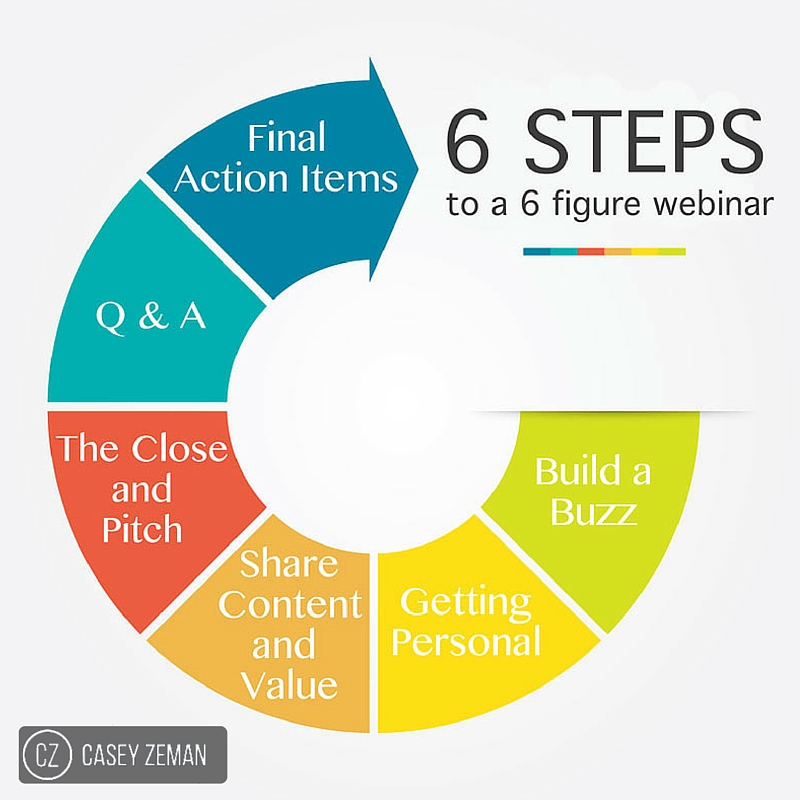
1. Building a Buzz
2. Getting personal
3. Share content and value
4. The close and pitch
5. The Q & A
6. Final action items
Let’s first talk about creating that buzz. Let me explain to you what this is. Whenever you’re going to be doing a live stream or webinar, I normally start off with welcoming the people that are coming in. I tell folks, “Hey guys, welcome to this event, this is what we’re going to be talking about, it’s really awesome. Close your distractions down because this is going to be extremely good stuff.” I let them know that we’re still waiting for more people to come in the door. I let them also know that maybe they want to share this with their followers on Twitter and Facebook.
The buzz is like how you may go to a musical and before the performance even gets started, sometimes the performers are in the audience connecting with the them, right? For instance the musical Cats, they had the cat creatures going through the audience and it just got you excited about the show. That’s what your buzz is supposed to do. In the beginning of your show, you want to build that excitement and energy. You want to let them know, “Hey, this is what you’re gonna expect. I have these things I’m going to be sharing with you.”
You also want to know who your viewers are. I always ask who is new to my broadcast and who has listened before. This starts building relationships.
Understand these words: anticipation and expectation. Let your viewers know what they’re going to be learning at the beginning of the event and during the event. Here’s something that I sometimes say at the beginning of my webinars, an example of the anticipation. “By the end of this webinar you’ll learn how you can use this three-part system of selling your products and services to a hungry audience within 48 hours.” That is one of those elements, let them know what they can expect. The time for the buzz should be about 5-10 minutes.
Getting Personal.
You need to get personal with your audience. You want to know who they are, and, the most important thing, you want them to know who you are. You need to tell your story. The way that you communicate and connect with your audience is by sharing your personal story, your personal growth, or hy they are on the call and how you relate to them.
I often talk about when I first started out online in 2011. I created a YouTube course, but I could not make money online. Until one day I decided to start using a webinar. I created a video on YouTube that said, “Hey guys, register for this webinar,” and that started driving traffic to my webinar. That is when I sold that my first dollar ever online.
If you’ve found this blog post helpful, pin me below to share!
You can give an overall arc of your story. Oftentimes I let people know that I was struggling. When I first started out, I was transitioning from a real estate job. One year I made $200,000, the next year I made $15,000. We almost went into foreclosure twice, so I had to figure out what I was going to do. I started following some people, Chris Ferrel was one, who teaches how to build an online business as a beginner. I went the direction of becoming a YouTube consultant. I chose a niche, jumped in, and then I saw success for other people, but I was still not seeing too much success with myself until I jumped into webinars.
I’m teaching you a strategy that you can do in your webinars that will help you reach success. If you guys look up Chris Ferrel, he has a Chris Ferrel membership platform that is devoted to teaching you the basics of online business. If you do connect with him, tell him Casey mentioned you. I remember when I did my first webinar, I completely bombed it. That’s something you guys should know, that you can do really poorly at these things but still succeed. It’s because you build up trust with your audience. That’s the power of webinars and why I use them and love them.
So, there’s this point in the webinar where you share your story and let them know who you are. Show social proof, show them why you’re the expert. Often times in my presentations I share not only my story of failed mortgage broker, failed actor, but then I talk about what events I’ve spoken at and various successes that I’ve had because they need to know that I’m an expert who knows what I’m talking about. You need to talk about yourself. Unfortunately, a lot of us don’t want to because we feel like we’re sharing too much of ourselves. It’s not bragging, you’re letting them know who you are so they can trust you.
Share your content and value.
This is essentially where you want to give your best stuff. This is the core part of the training. You’re gonna pull out all the stops and provide them with a ton of actionable content. This is also your opportunity to start connecting with your audience on a logical level. When you told your story, you connected with them on a heart level. Now, when you do your content, you want to make sure you’re talking about the logic.
What is the problem and what is the content that you’re teaching solve? This is what I say with webinars: “Webinars and online events have gotten huge in the last several years. Webinars are a billion-dollar industry and everyone is using them, such as HubSpot, the National Association of Realtors, and the University of Southern California.” I offer stats and marketing data and research to support my case. This is where you start identifying the problem and of course hinting to the solution. Back it up with stats and case studies. Case studies are very powerful.
Encourage them to follow along and take action on various things. For example, I sometimes have people go to their YouTube channel so they can follow along while I teach. All this while you are hinting to your solution and your solution is your product.
This leads me to the close and pitch.
The close and the pitch has the solution. Highlight the product’s benefit of the benefit. People often highlight the benefit of the product instead of highlighting the benefit of the benefit. I could tell you the Social Share feature brings you 10-15% more viral traffic, but that doesn’t tell you the benefit of the benefit. The benefit of the benefit would be that you could get an extra 10-15% viral traffic, which gets more people to your webinars, which essentially sells more of your product.
You have to always get to the end goal, which is selling more product, making more money, so you can have more free-time. This is what really matters to folks. This is where you’re going to have your testimonials. These are different from case studies. Testimonials are from people that you’ve worked with. Sometimes you can offer your services for free, get someone who can offer you a good testimonial and go from there.
Next is call to action in the close and the pitch. This is where you want to do a price break-down of your product. “We normally sell this for X, but for those of you on this call, we are selling it for Y.” This is where you really make the final call to action. “You can do this stuff yourself or you can come through and implement it at a much faster rate, which will in turn produce a greater result in a shorter period of time.” This is my call to action when I have people on the fence about purchasing.
Having testimonials and case studies are great, but hero stories is really where it’s at. “Before someone went through my program, they were at this point. After they went through my program they had 2,000 leads, etc…” Try to get that hero arc. Where were they before your product and where were they after? Find those little things.
Next is number five, the Q & A section.
This applies to any live stream. I always think a Q & A is so powerful. Use this to highlight benefits and handle objections or concerns with the product. You can often answer the same question multiple people have with just one answer.
After my Q & A, I start to do my final action item.
This is where I start saying, “Thank you for the Q & A.” I always thank my buyers. I always tell them the backend of what will happen after they buy. Take them through the process of what they’re now getting. Don’t cancel the call with the people that didn’t buy. Show them the backend as well, this makes them more comfortable.
I also have a count-down timer counting down the bonuses. I always have bonuses on my webinar and oftentimes is a fast-action bonus that they can only get when they take action on this webinar and that creates scarcity in my sales process. It’s unfortunately one of the ways you get people to buy. You have to offer something now otherwise they won’t come through.
If you use these six steps, you’ll find that reaching that 6 figure income will be a whole lot easier than just shooting in the dark. I hope you take the time to find out more about Easy Webinar and how it can help you grow your business faster!
Watch the entire Periscope broadcast below: